
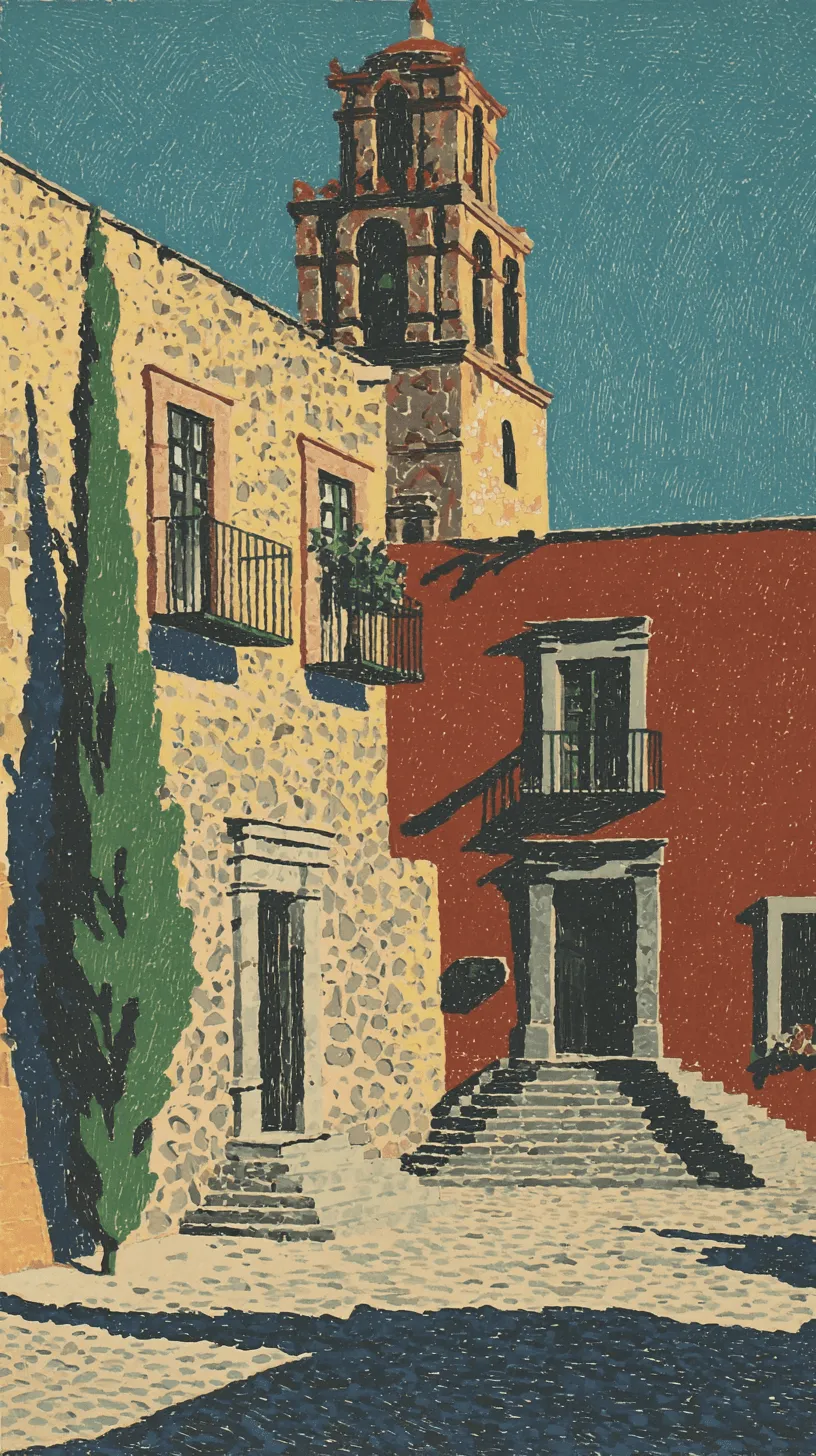
Neighbourhood
Centro Historico
The scarcity case for Centro Historico is the best-documented investment argument in San Miguel de Allende. It is also the one most often made without its counterweight: a capped land supply has not produced a capped listing supply.
- US$487k – 1.15m
- Asking range (no closed-sale data exists)
- MXN 45k – 90k
- Asking price per m²
Centro Historico is the only part of San Miguel where the supply ceiling is written into federal law, which is the whole of the investment case and none of the guarantee.
Centro Historico is the one part of San Miguel de Allende where the scarcity argument is not a sales line. It is a federal decree with a number in it.
The constraint, stated precisely
Two overlapping designations govern the core, and only one of them is law.
| Instrument | What it fixes | In force since |
|---|---|---|
| UNESCO World Heritage inscription, Protective town of San Miguel de Allende | 43.26 hectares of inscribed property, plus a 40.05 hectare buffer zone | 2008 |
| INAH zona de monumentos historicos, presidential decree | 0.75 square kilometres, 68 manzanas, divided into Perimetro A, B-1 and B-2 | 28 July 1982 |
| Article 4 of the same decree | 229 individual addresses itemised as monuments, each keyed to a region and manzana | 28 July 1982 |
| Article 5 of the same decree | Any construction, restoration or conservation work in the zone requires prior application to INAH | 28 July 1982 |
| CONAGUA determination, Cuenca Alta del Rio Laja aquifer | Deficit of 61,984,190 cubic metres a year, with no volume available for new concessions | 2024 study |
The UNESCO listing is a management designation. The operative Mexican instrument is the 1982 decree, and its wording is worth reading rather than paraphrasing: Article 5 requires that any obra de construccion, restauracion o conservacion inside the zone be carried out only after the owner has applied to INAH. Article 6 assigns enforcement to INAH. This is a federal permitting layer that sits on top of, not instead of, the municipal building permit.
Two details are usually smoothed over. The decree’s own header prints the area as 0.75 Km3; Article 2 correctly reads 0.75 square kilometres, and INAH states the same independently. And the 229-address count is derived from the text of Article 4, not announced by it. Owning one of those addresses changes what renovation is permitted, so a title search that stops at the escritura is incomplete.
The water constraint is harder and applies to the whole municipality. CONAGUA’s 2024 determination records recharge of 139.7 million cubic metres a year against 201.68 million of registered extraction, and states that no volume is available for new concessions. The 2015 determination put the deficit at 59.3 million. It has widened. Well-drilling vedas dating to 1958 and 1964 cover the municipality, so new water rights must generally be bought from existing concession holders rather than newly granted.
Scarce land is not scarce inventory
This is the part the supply argument usually omits. Nobody can build a new house on the Jardin. That has not stopped a large number of existing ones being offered at the same time.
| Measure | Figure | Period |
|---|---|---|
| Active listings in Centro, one brokerage’s colonia directory | 220 | 23 July 2026 |
| Next largest colonia in the same directory (Zirandaro) | 55 | 23 July 2026 |
| Third largest (San Antonio) | 48 | 23 July 2026 |
| Citywide active listings | 860, up from 593 a year earlier (+45%) | May 2026 |
| Citywide active listings, following month | 745 | June 2026 |
| Average months of inventory, citywide | 29.6, up from 17.6 | January to May 2026 vs 2025 |
| What the same source calls normal for this market | 15 to 18 months | Repeated in every monthly update |
Centro carries roughly a quarter of the citywide active total on its own, and four times the listing count of the next largest colonia. That is not the profile of a market where inventory is the binding constraint.
Every figure in that table needs the same caveat. San Miguel de Allende has no public transaction registry. The Guanajuato Registro Publico de la Propiedad records deed values but publishes no aggregates, and deed values are commonly understated for tax reasons anyway. AMPI’s San Miguel chapter publishes no market data. The local MLS is not publicly accessible and issues no aggregate reports. Every closing count, price and inventory figure on this page therefore traces to one brokerage reporting on its own MLS view. It is the best data available and we use it. It cannot be audited.
That source is also internally inconsistent. Its May 2026 update reports 197 closings year to date; its June update reports 186 through June, against a 2025 comparative that also shifts from 190 to 220. A year-to-date count cannot fall as the year progresses. Separately, it describes the fall from 860 listings to 745 as a reduction of 81 properties, which is 115. We publish the discrepancies rather than pick a side silently.
The citywide price picture that sits behind Centro is this: 404 resale closings in 2024, down from 425 in 2023; a reported 24.68 per cent increase in units sold in 2025, which implies roughly 504 closings but was never published as a count; total dollar volume up only 9.03 per cent over the same period; and an average sale price falling from $650,462 to $568,829, a decline of $81,633. Sales above $2 million fell from 19 to 12. More units, at lower average prices.
What Centro costs
| Area | Asking price per square metre (MXN) |
|---|---|
| Parque Juarez | 55,000 to 95,000 |
| Centro Historico | 45,000 to 90,000 |
| Guadiana | 50,000 to 85,000 |
| Balcones | 35,000 to 65,000 |
| Guadalupe | 35,000 to 60,000 |
| San Antonio | 32,000 to 55,000 |
| Atascadero | 30,000 to 55,000 |
| La Lejona | 25,000 to 38,000 |
| Zirandaro | 22,000 to 34,000 |
| Olimpo and Santa Julia | 16,000 to 25,000 |
| Citywide median | 28,500 |
| Citywide average | 34,500 |
Centro’s floor sits 30 per cent above the citywide average and 58 per cent above the citywide median. On whole properties the same source gives Centro Historico a band of MXN 8.5 to 20 million, or about US$487,000 to US$1,150,000.
The caveats are heavier than the figures. This is the only neighbourhood-level price table published anywhere, which is the sole reason it appears here, and it comes from one content aggregator that sells property investment packs. It cites four listing portals, meaning these are asking prices scraped from advertisements rather than recorded sale prices, and it discloses no sample sizes. All four portals block automated verification. At 29.6 months of inventory, asking prices sit systematically above clearing prices.
The same publisher’s citywide asking average works out at about US$390,000, against the brokerage’s closed-sale average of $568,829 for 2025. That gap is not an error to be split. The portals capture the peso-denominated domestic segment; the brokerage MLS captures the dollar-denominated foreign-buyer segment. They measure different markets and should never be blended.
Two weaker datapoints agree on the shape if not the level. Land in Centro Historico is put at MXN 18,000 per square metre against a city average of 10,650, which sits oddly below the same publisher’s figure for built property. Numbeo’s crowd-sourced series gives MXN 49,720 per square metre in the city centre against MXN 29,432.99 outside it, on nine contributors and 50 entries, which is statistically meaningless alone. What survives across all three is a centre-to-periphery ratio of roughly 1.7.
The only non-commercial anchors come from peer-reviewed work: an average property price of US$520,000 across San Miguel in 2017, and historic-architecture homes in the centre quoted at around US$3,000,000 on average just before the pandemic. The same paper records that prices here are quoted predominantly in dollars rather than pesos. That is the load-bearing finding. Centro tracks US buyer sentiment, not Mexican housing fundamentals.
Appreciation and days on market: nobody knows
There is no measured appreciation figure for Centro Historico. There is no repeat-sales index, no hedonic index, and no MLS time series broken out by colonia. The figure in circulation, 9 to 12 per cent over the twelve months to June 2026, is a modelled estimate with no stated method, no sample size and no repeat-sales basis, published by an aggregator that lists the brokerage among its own sources while that brokerage’s closed-sale data shows the citywide average falling 12.6 per cent and inventory nearly doubling.
Days on market is worse. The only figure available is roughly 150 days citywide, attributed to a specific brokerage market update. That update contains no days-on-market data of any kind. The number appears to be the aggregator’s own estimate wearing a citation that does not support it. No neighbourhood-level days-on-market data exists in any source.
The defensible position for a publisher with no commission at stake is the plain one: measured neighbourhood-level appreciation and days on market for San Miguel de Allende do not exist. Any page that quotes them is quoting a model.
Who actually owns Centro
The strongest neighbourhood-level evidence in this market is not about prices. It is peer-reviewed census work on who lives inside the UNESCO polygon.
The seven census tracts within that polygon held 1,803 foreign-born residents, which is 42 per cent of the municipality’s entire foreign-born population of 4,312. Foreigners made up 8 per cent of the 22,405 people living in those tracts. The single most concentrated tract was 15 per cent foreign, 549 of 3,545 residents; a peripheral south-east tract reached 29 per cent, 567 of 1,957.
Both halves matter. Two in five of the municipality’s foreign-born residents live inside 0.75 square kilometres, which explains why Centro prices track dollar sentiment. And 92 per cent of the people in those tracts were not foreign-born, which is a corrective to copy describing the core as an expat enclave. The author cautions that census figures here are conservative, and no defensible current count exists: the 2020 census says 4,312 foreign-born, local press claims more than 15,000, other estimates run to 25,000, and none is checkable.
Short-term rental performance
No source publishes short-term rental performance for Centro Historico. AirROI names Centro Historico among eight San Miguel neighbourhoods it tracks, but keeps the per-neighbourhood rates behind a paid tier. That is a purchasable gap rather than an unknowable one, and until somebody buys it, the citywide numbers are all there is.
| Citywide metric | Figure |
|---|---|
| Average daily rate | $210 |
| Occupancy | 29.9% |
| RevPAR | $64 |
| Active listings | 2,285 |
| Mean annual revenue per listing | $17,033 |
| Top 10% of listings | $5,242+ per month |
| Top 25% | $2,477+ per month |
| Median listing | $1,096 per month |
| Bottom 25% | $446 per month |
| Best month (February) | $2,877 revenue, 42.2% occupancy, $222 ADR |
| Worst month (June) | $1,594 revenue, 23.5% occupancy, $183 ADR |
Figures cover the twelve months to June 2026. The median listing grosses roughly $13,150 a year, about 23 per cent below the mean, and that is before the 16 per cent IVA on a furnished letting, a 20 to 30 per cent management fee, the 4 per cent state lodging tax, federal withholding, and the municipal permit below. Any yield claim built on the mean overstates the typical owner’s outcome.
The occupancy figure is contested. Four vendors scrape the same market and report 29.9, 38, 41 and 44 per cent. None publishes its method for handling blocked calendars or inactive listings, which is almost certainly the source of the spread. Publish the range, not a point.
The regulatory stack is four deep and is frequently reported as one item.
| Charge | Amount | Instrument |
|---|---|---|
| Municipal annual land-use permit for lodging | MXN 45,000 per fiscal year | Ley de Ingresos SMA 2026, Art. 24 fracc. XIV |
| One-time authorisation of change of land use to lodging | MXN 11,248.64 | Same law, Art. 24 fracc. XIII inciso d) |
| Guanajuato state lodging tax (ISH) | 4 per cent of consideration | Ley de Hacienda, Art. 55 |
| Federal IVA on a furnished letting | 16 per cent of consideration | Ley del Impuesto al Valor Agregado, Art. 20 fraccion II |
MXN 45,000 is about US$2,577 at the European Central Bank reference rate of 17.4601 on 23 July 2026. An owner converting a residential property pays both municipal charges in year one.
The IVA line is the one most often left out. Letting a dwelling is exempt from IVA, but Article 20 fraccion II withdraws that exemption for property supplied furnished, or destined for or used as a hotel or lodging house, so a furnished short-term let is taxable at 16 per cent however long the lease runs. That is a statutory position rather than an enforcement one. Whether it is in practice collected from individual foreign owners is undocumented, and no source discloses whether the scraped revenue figures above are quoted before or after it.
Enforcement history is specifically a Centro story. In all of 2022 the municipality collected MXN 175,442 from the land-use charge, from approximately 243 registered properties in the historic centre zone. The fee then rose from MXN 10,000 to MXN 45,000 for 2023 and has not moved since, including for 2026. In July 2026 the state tax authority sent roughly 5,000 invitation letters to platform hosts and publicly accused Airbnb of three and a half years of non-compliance. What nobody publishes is the compliance rate: there is no 2026 count of how many San Miguel short-term rentals actually hold and pay the permit. For an investor that is arguably the single most important regulatory number in this market, and it does not exist.
The downsides, at their real size
Tourist density. San Miguel recorded roughly 2 million visitors in 2025 with about MXN 14 billion in economic impact, on the municipal government’s own figures; a competing report gives 2.19 million visitors and 8.564 billion pesos, a 63 per cent gap on the economic number that neither side reconciles. Set the visitor figure against a municipal-seat population of 72,452 at the 2020 census. Nearly all of that footfall lands inside 0.75 square kilometres.
Noise and parking. No source measures either. There is no published noise data for the historic centre and no published count of off-street parking. Brokerages consistently describe Centro as cobbled, with older stock that often requires renovation, and the highest tourist footfall in the city. That is a description, not a measurement. Treat both as site-visit questions and visit at the hours you would actually be there.
Renovation friction. Article 5 is the hard constraint, and it is not a formality: it is a federal application, enforced federally, before work begins. If the property is one of the 229 catalogued addresses, the scope narrows further. What cannot be sourced is the practical shape of that process. The municipal building regulation sets heights case by case according to street width and neighbouring rooflines, with no numeric cap published. The municipal management plan and the 2019 to 2040 urban development programme could not be retrieved in full, so height limits, floor-area ratios and density caps by zone remain unsourced. Nobody publishes typical approval timelines or refusal rates.
Renovation cost, in the wrong currency. Centro asking prices are quoted in dollars; renovation labour and materials are paid in pesos. The ECB reference rate was 17.4601 on 23 July 2026, fewer pesos per dollar than either recent annual average, which the IRS puts at 18.330 for 2024 and 19.212 for 2025. Spot rates and annual averages are different measures and are routinely conflated: an average describes the level across a whole year, not a start-to-end move. The direction is what matters. A dollar converted today buys less peso-denominated work than the annual-average comparison implies.
Water. Centro appears in the most contaminated group on the Caminos de Agua monitoring map as reported in February 2022, alongside Santa Cecilia, Insurgentes, Mexiquito, San Rafael, Linda Vista, Olimpo, Ejido de Tirado, Las Brisas and Santa Julia. That report is four years old and gives no thresholds, no well counts and no study period, so it should not be read as current. The direction is corroborated: groundwater in the upper Rio Laja watershed is falling by as much as 3 metres a year in places, and arsenic and fluoride concentrations rise as the table drops. Measured concentrations by neighbourhood, with dates, are published nowhere we could reach. This is the least discussed line item in Centro due diligence and it belongs in the survey.
Security. Guanajuato carries a Level 3 United States advisory reissued on 29 May 2026, and that advisory does not name San Miguel de Allende anywhere; the sentence still widely republished as exempting the city is from a superseded version. San Miguel’s own profile is far quieter than the industrial south, at 3 homicides in June 2026 against 45 in Leon, 32 in Salamanca and 25 in Irapuato. It is not, however, an exception. Over the twelve months to August 2025 the municipality recorded 88 homicides, a rate of 49.3 per 100,000, making it Mexico’s 50th most violent municipality. And in February 2026 cartel reprisal violence reached roughly 23 Guanajuato municipalities including San Miguel, with an arson incident on 22 February and a body found on 25 February. Any page claiming San Miguel is insulated is wrong.
The premium is already banked. This is the quiet one. The supply constraint has been in force since 1982 and inscribed since 2008. It is not news, it is not mispriced, and it is fully reflected in a price band that starts above the citywide average and runs to roughly three times it. Buying Centro on the scarcity argument in 2026 means paying for a constraint that the market has had four decades to price.
What Centro is, stripped of adjectives
It is the most expensive part of a city whose average sale price fell 12.6 per cent in 2025 and whose inventory is running at roughly double its own definition of normal. Its supply ceiling is genuine, federal and unmoving. Its listing count is the largest in the city. Its appreciation rate is unmeasured, its days on market unmeasured, its rental yield unmeasured at neighbourhood level, and its noise and parking undocumented.
That combination argues for one kind of buyer and against another. If the walkable core is the point of the purchase and the property will be used, the constraint that keeps Centro rare is real and will keep it rare. If the purchase is being underwritten on a yield or an appreciation rate, the honest answer is that neither number exists, and a figure you cannot check is not a forecast.
All figures USD unless noted. Past performance does not guarantee future results.
Who buys here
- Buyers who want the walkable core itself and accept that the premium for it is already in the asking price.
- Owners with the cash and the patience for a renovation that needs federal consent from INAH before work begins, on a timetable nobody publishes.
- Anyone underwriting on use and capital preservation rather than rental yield. Centro is the most expensive place in the city to buy and, on the only published estimate, the lowest-yielding.
- Not for buyers who need quiet, off-street parking, or a quick exit. None of the three is documented, and the first two are structurally scarce.
Sources
- UNESCO World Heritage Centre — inscribed property and buffer zone areas for the Protective town of San Miguel de Allende · Inscribed 2008; figures current July 2026
- Decreto presidencial of 28 July 1982, Diario Oficial de la Federacion, via Sistema de Informacion Cultural (Secretaria de Cultura) — zona de monumentos historicos, Articles 2 to 6 · 28 July 1982; in force
- CONAGUA, Gerencia de Aguas Subterraneas — availability determination for the Cuenca Alta del Rio Laja aquifer (clave 1108) · 2024 study; REPDA cut-off 30 December 2022
- Realty San Miguel — monthly market updates (closing counts, average sale price, active listings, months of inventory), reported from one brokerage's own MLS view · December 2025 through June 2026
- Realty San Miguel — colonias directory, active listing counts by colonia. A live page whose values change · Retrieved 23 July 2026
- TheLatinvestor — asking price per square metre and whole-property ranges by neighbourhood, scraped from listing portals · Published 16 June 2026
- TheLatinvestor — land price per square metre by neighbourhood · Published 2 April 2026
- Numbeo — crowd-sourced purchase price per square metre, city centre versus outside centre (9 contributors, 50 entries) · Last updated 19 June 2026
- David Navarrete Escobedo, 'La gentrificacion trasnacional en America Latina: el caso de San Miguel de Allende', Iztapalapa vol. 43 no. 93, via SciELO Mexico — foreign residency by census tract inside the UNESCO polygon · Published 2022, on INEGI 2010 and 2020 census data
- AirROI — short-term rental analytics for San Miguel de Allende (ADR, occupancy, revenue distribution, seasonality) · Trailing twelve months, July 2025 to June 2026
- Ley de Ingresos para el Municipio de San Miguel de Allende 2026, Decreto 160, Articles 4 and 24 — lodging land-use permit fee and predial rates · Published 30 December 2025; in force fiscal 2026
- Camara de Diputados — Ley del Impuesto al Valor Agregado, Art. 20 fraccion II — furnished lettings and lodging use are excluded from the residential-letting exemption, so 16 per cent applies whatever the lease length · Ultima reforma DOF 12 November 2021
- Periodico Correo, quoting Municipal Treasurer Raul Vallejo Solis — land-use charge collected from platform lodging in the historic centre zone · Calendar year 2022; article dated 23 January 2023
- Discover San Miguel de Allende, reporting Caminos de Agua's water-quality monitoring map by colonia · Published 23 February 2022
- INEGI Censo de Poblacion y Vivienda 2020, via IPLANEG Guanajuato — municipal and municipal-seat population · 2020 census, state profile compiled 2024
- Periodico Correo, quoting Municipal President Mauricio Trejo Pureco — 2025 visitor volume and economic impact · Full year 2025; article dated 7 January 2026
- elcri.men analysis of SESNSP and INEGI data, reported by Mexico News Daily — San Miguel de Allende homicide count and rate · September 2024 to August 2025; published 8 October 2025
- Periodico AM 'Ejecutometro' — homicides by Guanajuato municipality · June 2026; published 2 July 2026
- European Central Bank reference rate via Frankfurter — USD/MXN on 23 July 2026 · 23 July 2026
- US Internal Revenue Service — yearly average currency exchange rates, Mexican peso · 2024 and 2025 annual averages
Common Questions
Why is property supply in Centro Historico San Miguel de Allende constrained?
A presidential decree of 28 July 1982 declared a zona de monumentos historicos covering 0.75 square kilometres and 68 city blocks, within which Article 5 requires prior application to INAH, the federal antiquities institute, before any construction, restoration or conservation work. Article 4 itemises 229 individual addresses as catalogued monuments. Separately, the UNESCO inscription covers 43.26 hectares with a 40.05 hectare buffer. The boundary has not moved since 1982, so the stock of buildings inside it is fixed.
How much does property in Centro Historico cost per square metre?
The only neighbourhood-level figure published anywhere puts Centro Historico at MXN 45,000 to 90,000 per square metre against a citywide average of MXN 34,500. It comes from one content aggregator, is scraped from listing portals, and therefore measures asking prices rather than sale prices. No price per square metre derived from closed sales exists for any San Miguel colonia. With citywide inventory running at 29.6 months, asking prices sit systematically above clearing prices, so treat the range as a ceiling rather than a market value.
What is the appreciation rate in Centro Historico?
No measured appreciation rate exists for Centro Historico or any other San Miguel neighbourhood. There is no repeat-sales index, no hedonic index, and no MLS time series broken out by colonia. The figure in circulation, 9 to 12 per cent over the twelve months to June 2026, is a modelled estimate from an aggregator that discloses no method and no sample, and it runs against the only closed-sale data available, which shows the citywide average sale price falling from $650,462 in 2024 to $568,829 in 2025.
Can you renovate a house in Centro Historico San Miguel de Allende?
Yes, but any construction, restoration or conservation work inside the historic monuments zone requires prior application to INAH under Article 5 of the 1982 decree, with enforcement assigned to INAH under Article 6. This is a federal requirement, separate from and additional to municipal building permits. If the property is one of the 229 addresses itemised in Article 4 of the decree, what is permitted changes materially. No source publishes typical approval timelines, refusal rates, or numeric height and density limits by zone.
What does a short-term rental in Centro Historico earn?
No source publishes short-term rental performance for Centro Historico specifically. AirROI names Centro Historico among eight San Miguel neighbourhoods but keeps per-neighbourhood rates behind a paid tier. Citywide over the twelve months to June 2026 it reports an average daily rate of $210, occupancy of 29.9 per cent, and a median listing grossing $1,096 a month, or roughly $13,150 a year before the 16 per cent IVA a furnished letting bears under Article 20 fraccion II of the value added tax law, management fees, the 4 per cent state lodging tax and the MXN 45,000 municipal permit.
Is Centro Historico noisy or hard to park in?
Almost certainly on both counts, but no source measures either. There is no published noise data and no published count of off-street parking in the historic centre. What is documented is the footfall: San Miguel recorded roughly 2 million visitors in 2025 against a municipal-seat population of 72,452 at the 2020 census, and the overwhelming majority of that traffic lands inside the 0.75 square kilometres of the protected zone. Buyers should treat noise and parking as a site-visit question, not a research question.
San Miguel de Allende · Heritage Equity
The report no agent will send you.
The SMA Wealth Intelligence Report. Transaction data, neighbourhood appreciation, and the full short-term rental yield distribution. No commission agenda, because we do not earn one.